
One of the key statements as a business owner is a profit and loss account. This tells you, ultimately, whether you’re winning or losing.
So, follow my video or read below, and I’ll explain what’s included in the profit and loss account and why it’s important for you, the business owner.
What is the profit and loss account used for?
First, this forms a part of the financial statements you are preparing for your limited company. But you will also prepare a Profit and Loss account if you’re a sole trader, partnership, or LLP.
This tells you how well you are doing. This is your scoreboard, like at a football event, where you can see your results.
What’s included in a profit & loss account?
When preparing this, you will start with your income from your main trade and expenses. Also, all your income and costs will exclude VAT if you are VAT-registered.
If you’re not a VAT-registered business or you’re exempt, all of your costs in your profit and loss account will be gross, including VAT, because you haven’t claimed the VAT back.
Important to note is this, as it’s easy for business owners to presume incorrectly.
Your costs are usually categorised in a few different ways. The first one is the cost of sales; these are expenses that directly relate to your earnings. An example of a construction business will be materials and subcontracted labour.
So, what tends to happen on a Profit Loss account is you’ll have sales less cost of sales equals gross profit.
This is usually a critical margin that people like to look at because you would look at your gross profit percentage to see how much you’ve earned compared to how much you’ve spent.
There are usually good benchmarks with industries to see how good a margin you make.
The second lot of expenses that are sometimes classified are selling costs. And these are items that you’re using to spend on to get future income. So, this could be Pay-per-click advertising, salespeople, etc.
I quite like selling costs on a P&L because this shows me how much the business owner is investing in the future.
The next type of cost will be administration costs. These are known as overheads; you can’t directly relate these to the business, but they are still essential for your business to run. As an example, these could be office costs, admin support, insurance and rent. These are not directly related to the generated income but still supporting your business.
You tend to find that many of these costs are fixed or stepped costs. A fixed cost is where it doesn’t change with income, and it stays fairly static until you get to a level where you have to upgrade, and then it stays at another level of fixed costs, which is known as a step cost.
To calculate your profit: gross profit, less your selling cost, less your admin expenses equals your profit before tax.
Let’s talk about tax
Ideally, every single business aiming for a profit. Sometimes, this doesn’t happen, especially with startups.
You want to make sure that you are maximising your profit as much as possible; this will lead to tax and tax planning. Your tax is a direct reflection of how much profit you’re earning.
HMRC will see a copy of your profit and loss account to see whether it looks in line; it’s not a review, as they’ve got various computer systems that use algorithms to check these.
in the UK, a lot of small business owners will take the combination of salary and dividends, you want to make sure that you have available money profits within your company to be able to pay these dividends.
In summary, your Profit and Loss Account contains:
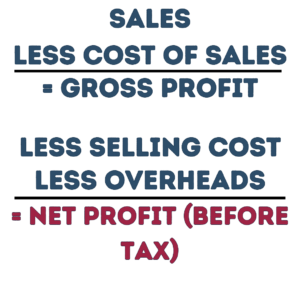
You take out your tax and dividends from your net profit to see how much available profit you’ve left in the business.
This could be important for many reasons; if you’re looking at financing your business where you’re growing and using loans to scale your business, the lending company wants to see if you are leaving money in the business to reinvest.
And what’s even more important is if you have taken all the profit out of your business, make sure you don’t have a whopping overdrawn Directors Loan Account.
producing a Profit Loss account
An easy way to produce a Profit Loss account will be on your cloud accounting software.
Make sure that the records are up to date, and that all of your transactions are reconciled for the profit and loss account to be meaningful.
With accounting systems, it’s quick and easy to prepare a P&L if you have everything in place.
So, do you have that system currently in place within your business? And how often are you reviewing your own profit and loss account?
I hope this really helped you, but if you have any questions that I can help with, please click my Calendly link below. I promise that I’ll answer all of your questions and get to know you a bit, and there’ll be no pushy sales pitch.